
Next.js in 2026: Why Modern Businesses Are Moving to Full-Stack React
React has been one of the most important technologies in modern web development for years.
But React by itself is primarily a UI library.
As applications have become more complex, development teams increasingly need much more than a component library. They need routing, server rendering, data fetching, caching, APIs, authentication, performance optimization, deployment, and a clear application architecture.
This is where Next.js has become particularly important.
In 2026, Next.js is no longer simply a framework developers choose because they want to build a React website.
It has evolved into a platform for building full-stack web applications.
The official Next.js documentation describes Next.js as a React framework for building full-stack web applications, with the framework handling many lower-level concerns so teams can focus more on building and shipping products. (Next.js)
For businesses building SaaS products, dashboards, e-commerce platforms, marketplaces, customer portals, and other digital products, that distinction matters.
React vs Next.js: What's the Difference?
One of the most common questions is:
"If we already have React, why do we need Next.js?"
The simplest way to think about it is:
React → UI
Next.js → Application
React provides the component model for building interfaces.
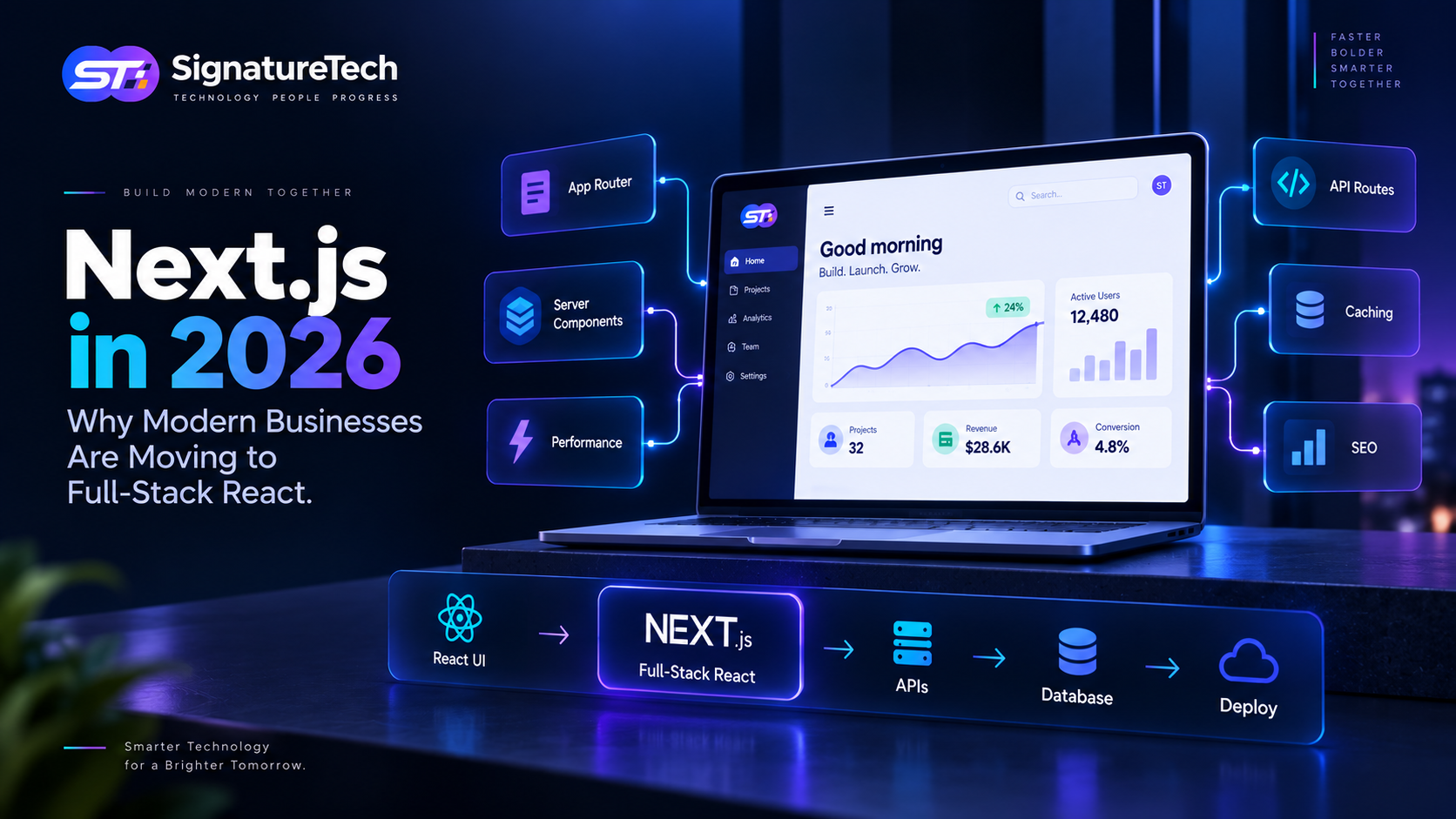
Next.js adds an application framework around React, including capabilities such as:
- Routing
- Server Components
- Server rendering
- Data fetching
- Caching
- Streaming
- API endpoints
- Authentication integration
- Metadata and SEO
- Image optimization
- Deployment tooling
Next.js supports both the newer App Router and the older Pages Router, although the App Router is where the newer React capabilities are integrated. (Next.js)
This allows development teams to build much more of the application within a consistent architecture.
Why Full-Stack React Matters
Traditionally, many web applications were split into separate systems:
Frontend
React / Vue / Angular
↓
API
Node.js / Laravel / Django / Rails
↓
Database
PostgreSQL / MySQL / MongoDB
This architecture is still completely valid.
But for many applications, having a separate frontend application and backend application introduces additional complexity.
You may need:
- Separate repositories
- Separate deployments
- API contracts
- Authentication coordination
- CORS configuration
- Duplicate types
- More infrastructure
- More CI/CD pipelines
Next.js allows teams to bring much of this application architecture together.
That doesn't mean every backend should be replaced with Next.js.
For complex systems, dedicated backend services can still be the better choice.
The advantage is flexibility.
The App Router Is Changing How React Applications Are Built
The Next.js App Router is based on React's newer capabilities, including Server Components, Suspense, and Server Functions. (Next.js)
Instead of thinking of every component as something that must execute in the browser, developers can decide which parts belong on the server and which require client-side interactivity.
This creates an important architectural distinction.
Server Components
Useful when the component primarily needs:
- Data fetching
- Server-side logic
- Database access through appropriate server-side layers
- SEO-friendly rendering
- Secure access to server-only resources
Client Components
Useful when the component needs:
- User interaction
- Browser APIs
- Local state
- Event handlers
- Client-side effects
Next.js uses Server Components by default for layouts and pages in the App Router. Client Components can then be introduced where interactivity requires them. (Next.js)
This means developers don't have to make the entire application client-side just because a small part of the interface is interactive.
Why Server Components Matter
Consider a product page.
It might contain:
- Product information
- Pricing
- Reviews
- Recommendations
- Add-to-cart button
- User-specific controls
Not everything needs to execute in the browser.
Server Components allow data-heavy or non-interactive parts of the interface to remain on the server while interactive elements can be implemented as Client Components.
This can reduce unnecessary client-side JavaScript and keep sensitive server-side logic away from the browser.
Next.js documentation notes that Server Components can help with data fetching, security, caching, bundle size, initial rendering, SEO, and streaming. (Next.js)
The architectural principle is simple:
Send the browser only what it actually needs to make the interface interactive.
Next.js Is More Than Server-Side Rendering
Next.js is often described as a server-side rendering framework.
That's now an incomplete description.
Modern Next.js applications can combine different rendering and data strategies.
A route can include:
- Prerendered content
- Cached data
- Dynamic data
- Streaming
- Client-side interaction
The result is not simply:
Server vs Client
Instead, modern applications can use a mixture of execution and rendering strategies depending on the requirements of each part of the application.
Caching Has Become an Important Part of Next.js Architecture
Performance isn't only about how quickly code executes.
It's also about avoiding unnecessary work.
Next.js provides several caching mechanisms and newer Cache Components capabilities allow developers to mix static, cached, and dynamic content within the same route. (Next.js)
The use cache directive can be applied at different levels, including routes, components, and functions, when Cache Components are enabled. (Next.js)
This opens up useful patterns for applications such as:
- SaaS dashboards
- E-commerce
- Content platforms
- Marketplaces
- Customer portals
- Business applications
For example, a product page could contain:
Cached product information
Dynamic inventory
Personalized recommendations
Interactive shopping controls
Instead of treating the entire page as either completely static or completely dynamic, the application can be designed around the characteristics of each piece of data.
Navigation Is Becoming Faster
Modern users expect web applications to feel like native applications.
They don't want every click to feel like a complete page reload.
Next.js provides built-in navigation optimizations such as prefetching, streaming, and client-side transitions. (Next.js)
When links become visible in the viewport, Next.js can prefetch routes so that information is already available when the user navigates.
This is particularly useful for applications with many routes and dashboards.
The goal is not merely faster server response time.
The goal is perceived application responsiveness.
Next.js Is Becoming More Relevant for SaaS
SaaS products often require a combination of:
- Public marketing pages
- Authentication
- Dashboards
- Account management
- Billing
- APIs
- Database access
- Analytics
- Admin interfaces
- SEO
- Dynamic content
A framework that can handle both the public website and application interface can simplify development.
For example:
Next.js Application

├── Marketing Website
├── Documentation
├── Authentication
├── Customer Dashboard
├── Admin Portal
├── Billing
├── API Routes
└── Application UI
This can allow a relatively small engineering team to maintain a cohesive application instead of managing multiple independent frontend systems.
Next.js Can Be Excellent for MVPs
For startups, development speed matters.
When building an MVP, teams want to validate a product quickly without creating unnecessary architectural complexity.
Next.js can be attractive because a single application can cover:
- UI
- Routing
- Server rendering
- Data fetching
- APIs
- Authentication integration
- SEO
- Deployment
This can reduce the number of moving parts in the early stages of a product.
But there is an important caveat:
Next.js doesn't automatically make an MVP simple.
Developers can still overengineer a Next.js application.
The framework is capable of supporting sophisticated systems, but an MVP should still use the simplest architecture that satisfies its requirements.
Next.js and SEO
SEO remains important for businesses that depend on organic acquisition.
A traditional client-heavy application can make SEO more complicated if important content isn't readily available in the initial HTML.
Next.js supports server-side rendering and prerendering, making it possible to deliver meaningful HTML for pages that need to be indexed.
The framework also provides built-in capabilities around metadata and Open Graph images. (Next.js)
This is particularly valuable for:
- Marketing websites
- SaaS landing pages
- E-commerce
- Blogs
- Documentation
- Product pages
- Marketplaces
For a business, the advantage isn't simply technical.
Better rendering architecture can support both user experience and organic acquisition.
Next.js Performance Is Not Automatic
This is an important point.
Using Next.js does not automatically produce a fast website.
You can still build a slow Next.js application.
Common causes include:
- Excessive Client Components
- Large JavaScript bundles
- Poor database queries
- Unoptimized images
- Slow third-party APIs
- Incorrect caching
- Waterfall requests
- Unnecessary client-side fetching
- Poorly designed components
The framework provides powerful tools.
Engineering decisions determine the outcome.
When Should You Use Client Components?
A common mistake when adopting the App Router is putting "use client" at the top of too many files.
Client Components are appropriate when you need things such as:
useState- Event handlers
useEffect- Browser APIs
- Client-side interaction
The official documentation specifically identifies state, event handlers, lifecycle logic, and browser-only APIs as common reasons to use Client Components. (Next.js)
But not every component needs to be client-side.
A useful approach is:
Start with Server Components. Add Client Components only where interactivity requires them.
This helps keep the client bundle focused.
When Next.js May Not Be the Best Choice
Next.js is powerful, but it isn't the answer to every problem.
A different architecture may be better when:
You Have a Large Existing Backend
If the business already has a mature backend platform, replacing or duplicating it may not make sense.
Next.js can work very well as a frontend or web application layer in front of an existing API.
You Need Complex Backend Processing
Heavy background processing may be better handled by dedicated backend services or workers.
You Have Highly Specialised Infrastructure
Some systems have requirements that don't fit naturally into a JavaScript-centric full-stack application.
Your Team Has Strong Expertise Elsewhere
Technology decisions should consider the engineering team's experience and the existing technology ecosystem.
The correct question isn't:
"Is Next.js the best framework?"
It's:
"Is Next.js the right architecture for this product?"
Next.js 16 and the Direction of Modern Web Development
Next.js development continues to move toward better application performance and more responsive experiences.
The Next.js project announced Next.js 16.3 in August 2026, including improvements such as faster development builds and rendering, along with Instant Navigation capabilities designed to make application navigation feel more immediate. (Next.js)
This reflects a broader direction in web development:
Less unnecessary client-side work + smarter server rendering + better caching + faster navigation.
The web is becoming increasingly application-like without requiring every application to become a traditional client-heavy SPA.
What This Means for Businesses
For business leaders, the technical details matter because architecture affects:
- Development speed
- Maintenance cost
- Performance
- SEO
- Developer productivity
- Scalability
- User experience
- Infrastructure complexity
Choosing Next.js can allow a team to consolidate several application concerns into a modern full-stack framework.
For the right product, this can reduce complexity and help teams move faster.
But the framework should always serve the product.
A Practical Next.js Architecture for a Modern SaaS
A typical architecture might look like:
                    Users
                      │
                      ▼
                Next.js App
                      │
        ┌─────────────┼─────────────┐
        ▼             ▼             ▼
     Marketing     Dashboard      Admin
        │             │             │
        └─────────────┼─────────────┘
                      ▼
                Server Layer
                      │
          ┌───────────┼───────────┐
          ▼           ▼           ▼
       Database      APIs      External Services
          │
          ▼
      PostgreSQL
For more complex products, this can evolve into:
Next.js
   │
   ├── Application APIs
   ├── Backend Services
   ├── Background Workers
   ├── Message Queue
   ├── Database
   ├── Cache
   └── External Integrations
The key is that the architecture can evolve as the business grows.
Next.js in 2026: The Bigger Picture
The biggest reason businesses are interested in Next.js isn't because it is fashionable.
It's because the boundaries between frontend and backend development are changing.
Modern applications increasingly require:
UI + Server Logic + Data + APIs + AI + Automation + Performance
A framework that can bring many of these pieces together can be valuable for product teams.
At the same time, organizations should avoid treating frameworks as architecture by themselves.
A good engineering team still needs to decide:
- What belongs on the server?
- What belongs in the browser?
- What should be cached?
- What should be dynamic?
- Where should APIs live?
- Which data requires authorization?
- Which workloads need background processing?
- When should services be separated?
Next.js provides the tools.
Architecture provides the solution.
Final Thoughts
Next.js has evolved significantly from its early identity as a React framework focused primarily on server rendering.
In 2026, its value is much broader.
It provides a foundation for building modern full-stack applications with:
- React
- App Router
- Server Components
- Client Components
- Server rendering
- Streaming
- Caching
- APIs
- Routing
- SEO capabilities
- Performance optimizations
For startups, SaaS companies, and businesses building new digital products, this can make Next.js a strong choice.
But the goal shouldn't be to use Next.js because everyone else is using it.
The goal should be to use it when its architecture aligns with the product.
Choose technology based on the problem. Build the architecture around the product. And use the framework to help your team ship better software faster.
At SignatureTech, we use modern web technologies based on the specific requirements of the product—not simply because a technology is popular. For businesses building SaaS platforms, customer portals, marketplaces, dashboards, and custom web applications, the right architecture can make a significant difference in development speed, performance, and long-term maintainability.
Modern web development isn't about choosing more technology. It's about choosing the right technology—and using it well.