
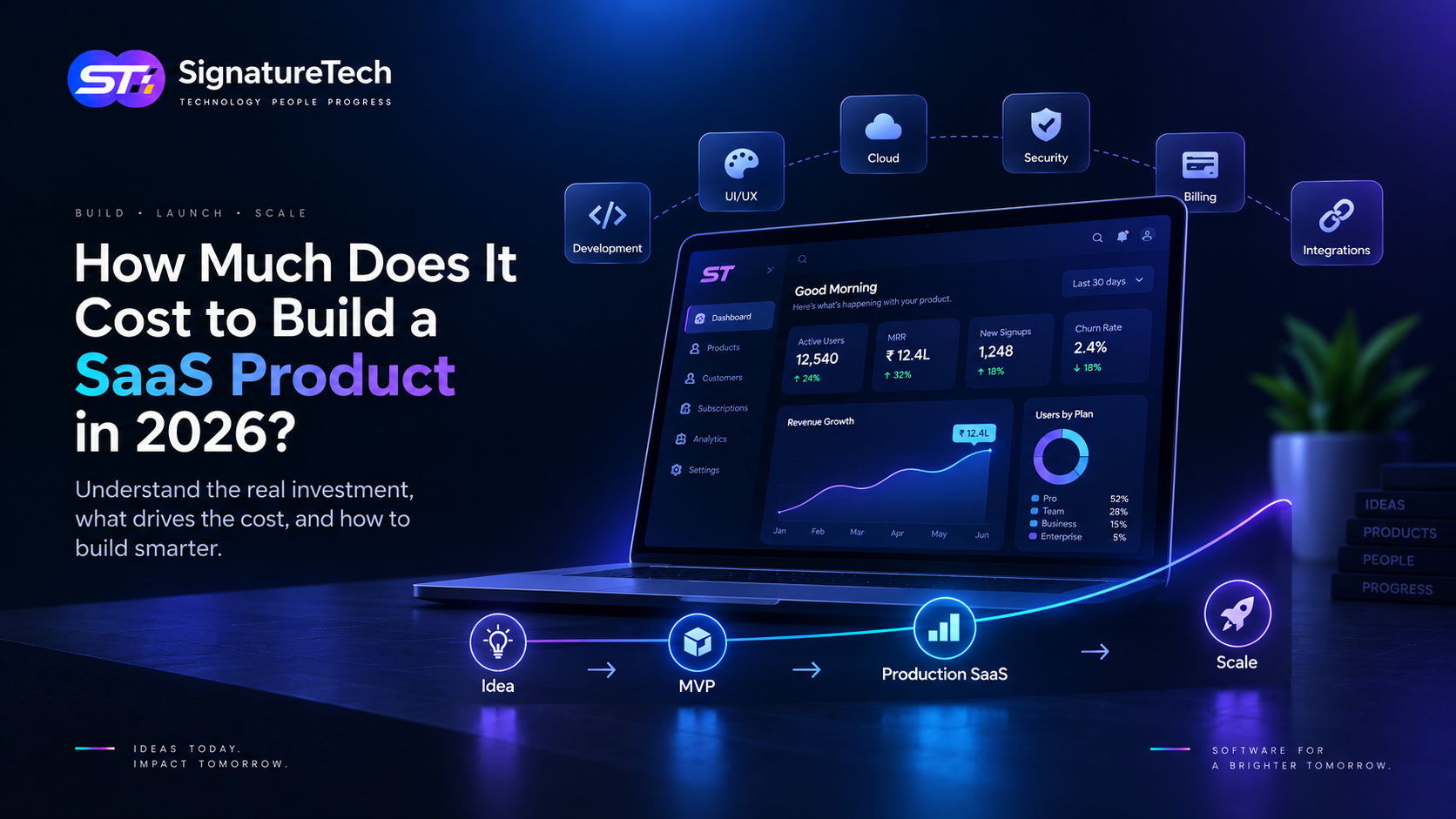
How Much Does It Cost to Build a SaaS Product in 2026?
One of the first questions founders ask when planning a SaaS product is:
"How much will it cost to build?"
The difficult part is that there isn't one universal answer.
A simple SaaS application with one core workflow might cost a few lakh rupees to build, while a multi-tenant platform with complex permissions, billing, integrations, analytics, mobile applications, and enterprise requirements can require a much larger investment.
Recent 2026 cost guides from Indian development companies show a wide range—from roughly ₹4–8 lakh for a lean SaaS MVP to ₹15–30 lakh or more for more advanced MVPs, while more complex production SaaS platforms can move substantially higher.
The important point is:
SaaS development cost is driven more by scope and complexity than by the number of screens.
This guide explains what actually determines the cost and how to plan a realistic SaaS development budget in 2026.
SaaS Development Cost at a Glance
As a practical planning framework for an India-based development team:
| Product Stage | Typical Budget | Approx. Timeline |
|---|---|---|
| Prototype / Proof of Concept | ₹1–4 lakh | 2–6 weeks |
| Lean SaaS MVP | ₹4–8 lakh | 6–10 weeks |
| Standard SaaS MVP | ₹8–15 lakh | 8–14 weeks |
| Advanced MVP / V1 | ₹15–30 lakh+ | 12–20+ weeks |
| Complex SaaS Platform | ₹30 lakh+ | 5–12+ months |
These are planning ranges, not fixed market prices. The final cost depends on product scope, team composition, integrations, security requirements, design complexity, and infrastructure.
For comparison, other current 2026 industry guides place professional SaaS MVP development anywhere from approximately $15,000 to $40,000 for simpler products and higher for more complex multi-role or integration-heavy systems
Why SaaS Products Cost More Than Websites
A business website primarily presents information.
A SaaS product has to operate as software.
A typical SaaS platform may need:
- User registration
- Authentication
- Password recovery
- User profiles
- Organizations or workspaces
- Role-based permissions
- Database architecture
- Subscription billing
- Payment processing
- Email notifications
- Admin dashboard
- Analytics
- APIs
- File storage
- Security controls
- Backups
- Monitoring
- Deployment infrastructure
That's why comparing the cost of a marketing website with the cost of a SaaS platform isn't particularly useful.
A website primarily communicates.
A SaaS product needs to store, process, secure, and deliver business functionality.
1. Prototype: ₹1–4 Lakh
If your goal is to validate an idea rather than launch a complete SaaS product, you may not need a full MVP.
A prototype can include:
- Key UI screens
- Clickable workflows
- Basic frontend
- Demonstration data
- Product concept
- Investor/demo presentation
The objective is to answer:
"Does this product concept make sense?"
This stage is particularly useful before significant development investment.
However, a prototype shouldn't be confused with a production-ready application.
2. Lean SaaS MVP: ₹4–8 Lakh
A lean SaaS MVP typically focuses on one core problem.
For example:
- User authentication
- One primary workflow
- Basic dashboard
- Basic admin functionality
- Database
- Essential notifications
- Production deployment
You might build something like:
Login → Create → Manage → Complete core task
and deliberately leave advanced functionality for later.
Current 2026 India-focused guides commonly place lean SaaS MVPs around the ₹4–8 lakh range, depending on scope.
This is often the best starting point for early-stage validation.
3. Standard SaaS MVP: ₹8–15 Lakh
Once your product requires more than one simple workflow, the budget increases.
A standard SaaS MVP might include:
- Authentication
- Multiple user roles
- Dashboard
- Core product workflow
- Admin panel
- Subscription or payment integration
- Email notifications
- Basic analytics
- Production infrastructure
- QA and testing
For example:
Customer + Admin + Billing + Core Workflow
A number of current 2026 Indian SaaS development guides place this type of product around ₹8–15 lakh.
4. Advanced SaaS V1: ₹15–30 Lakh+
This is where the product starts becoming a serious commercial platform.
You may need:
- Multiple user types
- Multi-tenancy
- Advanced permissions
- Subscription plans
- Usage-based billing
- Multiple integrations
- Analytics
- Audit logs
- Advanced admin tools
- Search
- Notifications
- File management
- Background jobs
- Reporting
- Advanced onboarding
At this point, you're no longer simply testing whether the idea works.
You're building a product that customers can use operationally.
Some 2026 Indian development guides place advanced MVPs in the ₹15–30 lakh+ range, depending on complexity.
5. Complex SaaS Platform: ₹30 Lakh+
A complex SaaS platform can quickly move beyond the typical MVP budget.
Examples include:
- Enterprise HRMS
- CRM platforms
- Financial software
- Marketplaces
- Logistics platforms
- Healthcare systems
- Multi-sided SaaS
- AI-powered enterprise platforms
These products may require:
- Complex multi-tenancy
- Advanced RBAC
- Audit trails
- Multiple integrations
- High-volume processing
- Real-time functionality
- Advanced analytics
- Mobile applications
- Enterprise authentication
- Compliance requirements
- Dedicated infrastructure
At this stage, architecture and operational requirements become major cost drivers.
What Actually Determines SaaS Development Cost?
The biggest mistake is estimating cost based purely on the number of pages.
A SaaS product with 20 simple screens can be cheaper than a product with 10 highly complex workflows.
Here are the factors that matter most.
1. Number of User Roles
Consider the difference between:
Single user
and:
Admin → Manager → Employee → Customer → Super Admin
Every additional role can introduce:
- Permissions
- Dashboards
- Workflows
- Access rules
- Testing requirements
Role complexity can significantly increase development effort.
2. Core Workflows
This is one of the biggest cost drivers.
For example:
Simple
User creates a document.
More complex
User creates a document → sends it → receives approval → requests payment → generates invoice → tracks status → exports report.
The second system requires considerably more business logic.
That's why workflow complexity matters more than screen count.
3. Multi-Tenancy
A SaaS platform typically serves multiple organizations.
You need to decide how tenant data is isolated.
Common approaches include:
- Shared database
- Shared database with separate schemas
- Database-per-tenant
- Hybrid architecture
Multi-tenancy affects:
- Database architecture
- Authorization
- Data isolation
- Migrations
- Backups
- Reporting
- Infrastructure
- Security
If you're building a serious B2B SaaS product, tenancy should be considered early rather than retrofitted later.
4. Billing and Payments
Billing can look simple from the outside.
But production billing often involves:
- Plans
- Trials
- Coupons
- Upgrades
- Downgrades
- Renewals
- Failed payments
- Refunds
- Invoices
- Taxes
- Webhooks
- Subscription state management
If you're selling internationally, you may also need multiple payment providers and currencies.
Billing deserves proper engineering because mistakes directly affect revenue.
5. Third-Party Integrations
Integrations can significantly increase development time.
Examples:
- Stripe
- Razorpay
- Google Calendar
- Microsoft 365
- Slack
- CRM platforms
- Accounting systems
- Shipping providers
- AI APIs
A simple API integration may take relatively little time.
A complex two-way integration with synchronization, retries, webhooks, and error handling can take much longer.
6. UI/UX Complexity
Design isn't simply about making screens look good.
Complex products require:
- Information architecture
- Design systems
- Responsive layouts
- User flows
- Empty states
- Loading states
- Error states
- Accessibility
- Component systems
A polished SaaS application needs more design work than a basic CRUD interface.
7. Security
Security shouldn't be treated as an optional feature.
Depending on the product, you may need:
- Secure authentication
- RBAC
- Encryption
- Audit logs
- Rate limiting
- Secure API design
- Data isolation
- Backup strategy
- Monitoring
- Vulnerability management
Enterprise customers may additionally require compliance with standards or regulations relevant to the product and market.
Security requirements can significantly affect both development and infrastructure costs.
8. AI Features
Adding AI doesn't automatically make a SaaS product expensive.
A simple AI feature might involve:
User input → AI API → Response
But an AI-powered SaaS platform may require:
- RAG
- Vector databases
- Embeddings
- Document processing
- AI agents
- Tool calling
- Model routing
- Evaluation
- Guardrails
- Usage tracking
- Prompt management
- Cost controls
The complexity can therefore range from relatively small to substantial.
9. Mobile Applications
A web-only SaaS product is different from:
Web + iOS + Android
Mobile applications add:
- Mobile UI/UX
- App development
- Device testing
- Push notifications
- App-store deployment
- Mobile-specific authentication
- Offline or background functionality
If mobile isn't necessary for the MVP, delaying it can significantly reduce the initial investment.
Where Your SaaS Budget Goes
A typical SaaS project budget can be divided across several areas:
| Area | Typical Importance |
|---|---|
| Product discovery | High |
| UI/UX | Medium–High |
| Frontend | High |
| Backend | Very High |
| Database | Medium–High |
| Integrations | Variable |
| QA | High |
| DevOps | Medium–High |
| Security | High |
| Project management | Medium |
| Post-launch support | High |
The exact percentage varies considerably by product.
For a backend-heavy SaaS, backend engineering may consume more of the budget.
For a highly visual consumer product, UX and frontend may represent a larger portion.
Don't Forget Post-Launch Costs
Development isn't the end of the SaaS budget.
You also need to consider recurring costs.
Infrastructure
- Cloud servers
- Database
- Object storage
- CDN
- Backups
Communication
- SMS
- Push notifications
Monitoring
- Error tracking
- Logs
- Infrastructure monitoring
Third-Party Services
- Payment providers
- Maps
- Analytics
- AI APIs
- External integrations
Maintenance
- Bug fixes
- Security updates
- Dependency updates
- Performance improvements
Product Development
The most important ongoing cost is often continued product development.
Your first release is unlikely to be your final product.
How Much Should You Budget for Year One?
A useful planning approach is:
Initial development + infrastructure + third-party services + maintenance + iteration
Don't spend your entire budget on the first release.
For example, if you have ₹15 lakh available, spending the entire amount on development may be risky.
A better strategy could be:
₹9–11 lakh → Initial product
₹1–2 lakh → Infrastructure and services
₹2–4 lakh → Post-launch iteration and improvements
The exact allocation depends on the business, but keeping a post-launch budget gives you room to respond to real customer feedback.
How AI Is Changing SaaS Development Costs
AI coding tools are making certain development tasks faster.
Developers can use AI to assist with:
- Boilerplate
- Code generation
- Tests
- Documentation
- Refactoring
- Debugging
- Code analysis
This can improve developer productivity.
But there's an important distinction:
Faster coding does not automatically mean cheaper product development.
The difficult parts of SaaS development often remain:
- Product decisions
- Architecture
- Security
- UX
- Business logic
- Integration design
- Testing
- Deployment
- Long-term maintenance
AI can reduce implementation effort, but experienced engineering judgment is still critical.
How to Reduce SaaS Development Cost
The best way to reduce cost isn't necessarily to find the cheapest developer.
It's to reduce unnecessary complexity.
1. Build One Core Workflow
Don't build five products inside your first release.
2. Reuse Proven Components
Use mature frameworks and libraries.
3. Use Managed Infrastructure
Avoid managing infrastructure that doesn't create competitive advantage.
4. Delay Non-Essential Features
Advanced analytics, complex automation, mobile apps, and AI features can often come later.
5. Validate Before Scaling
Don't build infrastructure for millions of users before you have hundreds.
6. Define Scope Clearly
Ambiguous requirements are one of the easiest ways for development costs to increase.
The Cheapest Quote Isn't Always the Cheapest Product
Suppose you receive three quotes:
₹5 lakh
₹12 lakh
₹20 lakh
It may be tempting to select ₹5 lakh immediately.
But you need to compare what each proposal actually includes.
Ask:
- Who is building it?
- What's included?
- Is UI/UX included?
- Is QA included?
- Is deployment included?
- What happens after launch?
- Who owns the source code?
- Are third-party services included?
- How is security handled?
- What is the technology stack?
- How are change requests handled?
A low initial quote can become expensive if the product requires major rework later.
What Should You Build for Your First SaaS Version?
For most startups, the first release should answer one question:
Will customers use and pay for this solution?
That usually means focusing on:
Authentication
→ Core workflow
→ Value delivery
→ Basic billing
→ Admin/support
→ Analytics
Everything else should be evaluated against that objective.
A Practical SaaS Development Roadmap
A typical project can be structured like this:
Phase 1 — Discovery
Define:
- Target customer
- Problem
- Core workflow
- MVP scope
- Success metrics
Phase 2 — UX/UI
Create:
- User flows
- Wireframes
- Design system
- High-fidelity screens
Phase 3 — Architecture
Define:
- Frontend
- Backend
- Database
- Authentication
- Tenancy
- APIs
- Infrastructure
Phase 4 — Development
Build the core product.
Phase 5 — QA
Test:
- Functional workflows
- Permissions
- Security
- Performance
- Payments
- Integrations
Phase 6 — Launch
Deploy production infrastructure and onboard initial users.
Phase 7 — Iterate
Use real customer behaviour to decide what to build next.
The Most Important Cost Question
Instead of asking:
"How much does a SaaS product cost?"
ask:
"What is the smallest SaaS product we can build that proves our business model?"
That question changes everything.
If you can validate your product with ₹6 lakh instead of spending ₹30 lakh before launch, you reduce your risk dramatically.
Once customers validate the product, you can invest more confidently in:
- Scalability
- Automation
- AI
- Advanced analytics
- Mobile applications
- Enterprise features
- Integrations
Final Thoughts
There is no single price for building a SaaS product in 2026.
A realistic budget can range from a few lakh rupees for a focused MVP to tens of lakhs or more for a complex production platform. Current 2026 estimates from Indian development firms show how widely costs vary based on scope, from lean MVPs around ₹4–8 lakh to advanced products at ₹15–30 lakh or more
The biggest cost drivers are usually:
Product scope + workflows + user roles + integrations + billing + security + infrastructure
Not the number of pages.
The smartest approach is to build the smallest useful version, validate it with real customers, and expand based on evidence.
At SignatureTech, we approach SaaS development as product engineering—not simply feature development. The goal is to create a focused first version that can validate the business while providing a technical foundation for future growth.
Don't ask how much it costs to build everything. Ask how much it costs to prove the right thing first.